Word Processing Software: 1980-1989
For a large portion of the twentieth century, typewriters were the go-to tool for document creation. They came with challenges. It wasn't terribly easy to undo a mistake, and there was not a huge degree of formatting flexibility. At the dawn of the 1980s, there was a great deal of excitement around the idea of being able to produce a document without a typewriter being involved, and the ease with which you could undo mistakes using a word processor.
Sinclair ZX Spectrum
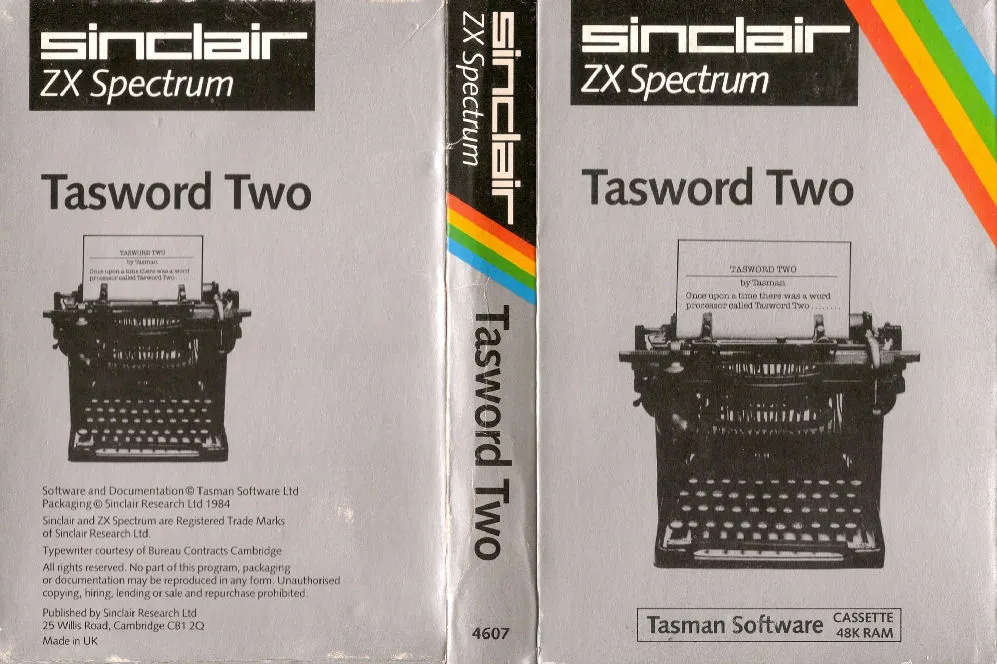
Tasword Two: Squeezing 64 characters per line onto a standard CRT television.
When we talk about the UK computing boom of the 1980s, the Sinclair ZX Spectrum is always front and center. While its iconic "dead flesh" rubber keyboard wasn't exactly designed for touch-typing a masterpiece, that certainly didn't stop an entire generation of writers from trying.
The undisputed king of Spectrum word processing was Tasword Two. Released in 1983, it pulled off an absolute technical miracle. The Spectrum natively only supported 32 characters per line on the screen, which was incredibly frustrating for formatting standard printed documents. Tasword Two completely bypassed this hardware limitation by utilizing custom software rendering to squeeze 64 characters onto a single line. It gave home users a true, usable layout!
Apple II / Apple IIe
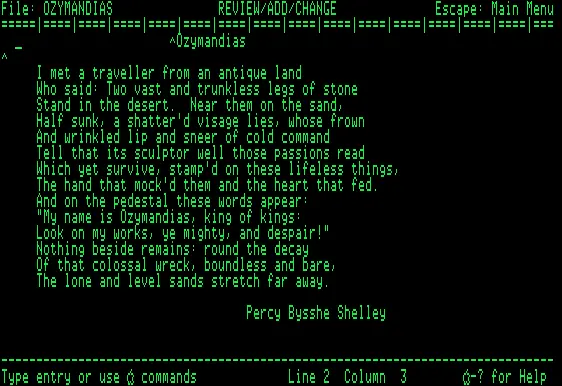
AppleWorks: Not my image. Original image from Blake Patterson.
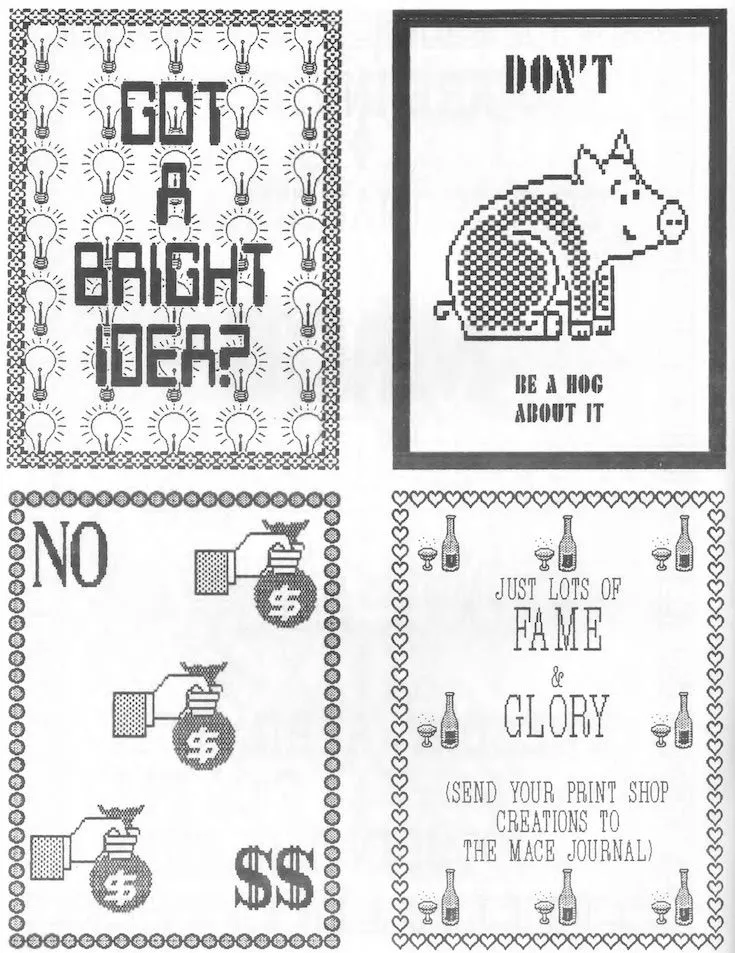 A look back at The Print Shop. Not my image. Original image from Paleotronic Magazine.
- AppleWriter: Written by Paul Lutus, this was an incredibly popular series of word processors that was eventually overtaken by AppleWorks. Paul agreed in 1992 to make AppleWriter available as freeware.
- AppleWorks: This wasn't just a word processor; it was a massive all-in-one productivity suite. Long before modern software companies started charging endless monthly subscriptions, AppleWorks gave you a powerful word processor, a spreadsheet, and a database for one price. All three of these were yours to own forever on a single floppy disk. Its famous "file card" interface was so incredibly efficient that it kept the aging Apple II hardware relevant in offices and homes for years after it should have been obsolete.
- Bank Street Writer: Early 1980s word processing usually meant memorizing a massive manual of complex keyboard commands just to delete a sentence. Bank Street Writer completely changed the game. Published by Broderbund and developed with actual educators, it was designed specifically to be intuitive for beginners and children. It famously required users to switch back and forth between a "Write" mode (for typing) and an "Edit" mode (for making changes). While that feels clunky today, it was a massive, welcoming leap forward in user-friendly design back then!
- The Print Shop: Technically not a word processor, but it was somewhat adjacent to word processing. In the mid-eighties, it was how everyone made banners and cards, and one of Broderbund's biggest selling programs. If you were at a birthday party in the mid-eighties, it is almost guaranteed that the banner that said "HAPPY BIRTHDAY!" had been printed using The Print Shop.
Commodore VIC-20
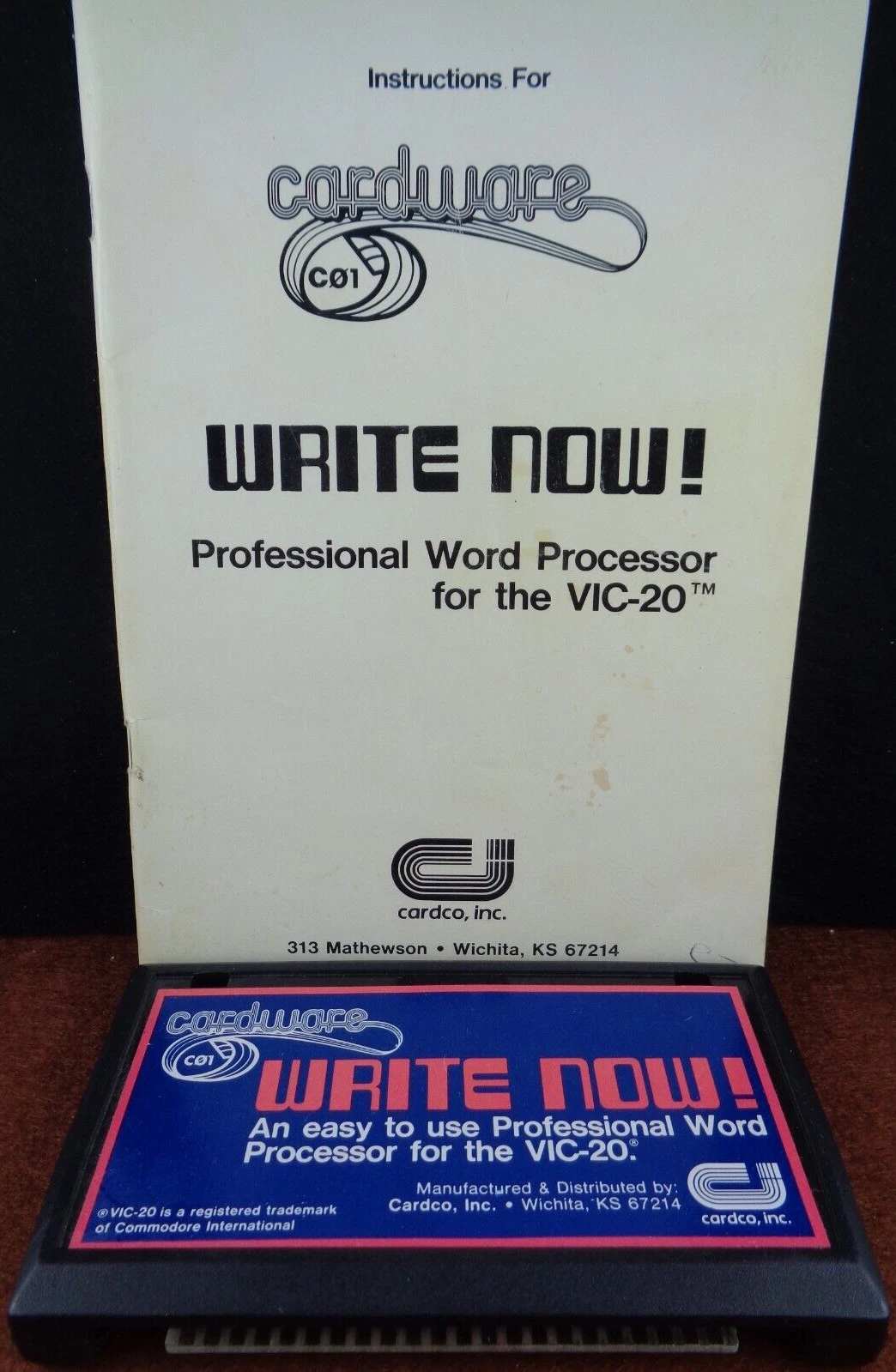
Cardco's "Write Now" word processor on cartridge, together with the instruction manual.
- VIC Writer: A 1981 release from Commodore which they presumably intended to be the official word processor for the VIC 20. Users had to use an 8K RAM expansion to run the program.
- Quick Brown Fox: A word processor which contained a somewhat unique feature for its time, as it supported sending and receiving text via RS-232 using the "Send and Recieve" feature, which meant it could be used with modems.
- Write Now: Shout out to Cardco in Wichita, Kansas! A version of this word processor was also produced for the Commodore 64.
Commodore 64
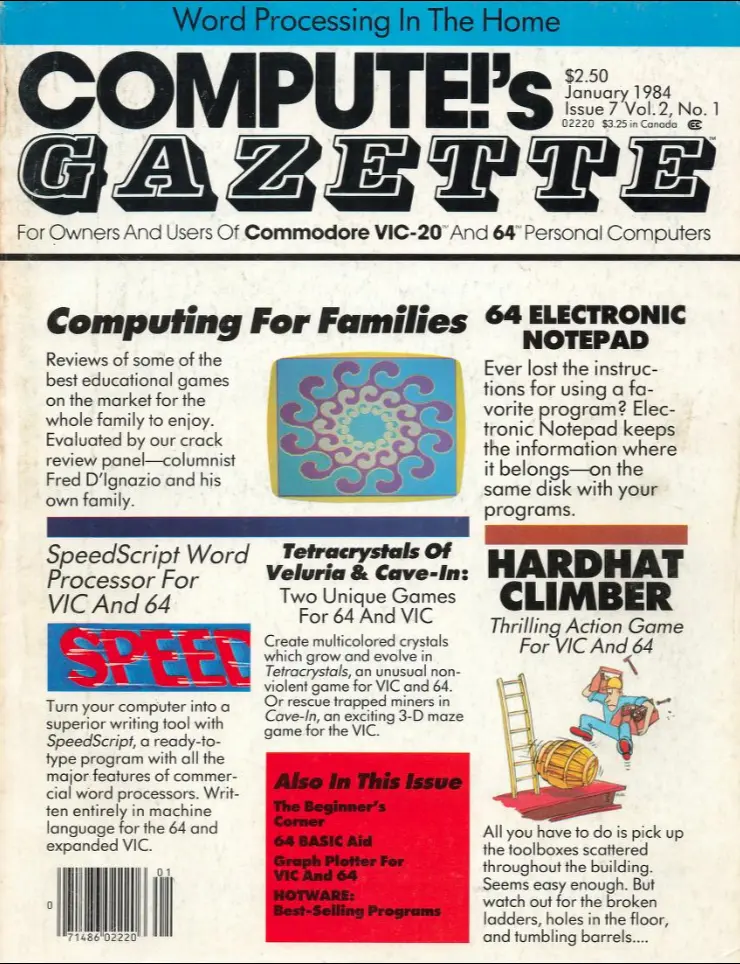
The January 1984 issue of Compute's Gazette, which gave you the type-in code to create SpeedScript Word Processor.
- EasyScript: Developed by Commodore themselves, this was heavy-duty, professional software. It was incredibly powerful, but mastering it required memorizing a dizzying array of complex formatting commands.
- PaperClip: Produced by Batteries Included, PaperClip was perhaps the definitive C64 word processor. It was incredibly robust, supported a massive range of third-party printers, and famously required a physical hardware "dongle" plugged directly into the machine's joystick port just to prevent software piracy!
- Vizawrite: While many early C64 word processors relied on embedding strange formatting codes directly into your paragraphs, Vizawrite pushed the 8-bit machine closer to a modern WYSIWYG (What You See Is What You Get) experience. It was so highly regarded that it was frequently bundled for free when you purchased a disk drive.
- SpeedScript: Unlike the other programs on this list, SpeedScript was not sold commercially. This was a type-in program from the January 1984 issue of Compute!'s Gazette. For the low cost of $2.50, the January 1984 issue gave you the code to type in this word processing program, plus you got the code to type in for the game Hardhat Climber.
- AtariWriter: This was arguably the undisputed king of Atari 8-bit word processors. Because it was released on a physical ROM cartridge rather than a floppy disk, it loaded instantaneously and left the computer's precious RAM entirely free for your actual documents. It was fast, easy to use, and featured a print preview mode that allowed you to scroll across a virtual page before committing it to paper.
- Letter Perfect: Published by LJK Enterprises, this was one of the earliest professional-grade word processors for the Atari. Its standout feature was a database merge capability. If you also owned their companion software "Data Perfect," you could automate the printing of personalized form letters. This was a massive productivity boost for home office users in the early 1980s!
- Word Magic: Published by Antic Software, Word Magic was a highly reliable text editor favored by many enthusiasts. It was particularly notable for having a fantastic companion spell-checker that integrated seamlessly with the word processor, giving writers a much-needed digital safety net before printing their final drafts.
- WordStar: Before Microsoft Word completely took over the world, WordStar was the undisputed king of professional writing on CP/M and DOS systems. It was famous for the "WordStar Diamond", which was a specific layout of keyboard shortcuts using the Ctrl key (Ctrl+S, E, D, X) that let writers navigate their documents incredibly fast without ever moving their hands off the home row. It was the absolute peak of pure, focused writing.
- LocoScript 2: LocoScript was the definitive word processing experience for the Amstrad ecosystem. It was so highly integrated that on many Amstrad PCW models, you didn't even load an operating system first; instead, you booted the computer directly into LocoScript. It essentially turned an affordable home computer into a dedicated, professional typing terminal!
- Protext: If you wanted serious speed and power on the CPC, Protext was the answer. It was a remarkably fast, command-driven word processor that was so highly regarded it eventually got ported to almost every major computing platform in Europe, including the Amiga and Atari ST.
- MacWrite: Bundled with the early Macintosh computers, MacWrite was the very first taste of GUI word processing for millions of people. With a click of a mouse, you could swap between fonts like Geneva, Chicago, and Monaco. By today's standards, it was incredibly basic, but in 1985, seeing your page layout on a crisp white screen before printing it was pure science fiction.
- Microsoft Word 1.0 (for Mac): While Word had previously existed as a clunky DOS program, the 1985 Macintosh release was where Microsoft truly showed its teeth. It took full advantage of the Mac's mouse and drop-down menus, and famously introduced the ability to have multiple document windows open at the exact same time, which was a massive advantage for professional writers and researchers.
- Lotus Jazz: Highly anticipated as the ultimate "Lotus Macintosh Product," Jazz was a massively ambitious 5-in-1 integrated software suite that included a word processor, spreadsheet, database, graphics, and communications module. Unfortunately, it tried to do too much at once on early Mac hardware. It was notoriously memory-hungry, sluggish, and incredibly expensive, making it a fascinating historical flop despite its incredible vision.
- pfs: Write: Developed by Software Publishing Corporation, the pfs: series was the absolute champion of the everyday, casual user. While programs like Word catered to power users, pfs:Write intentionally stripped away complex features in favor of extreme ease-of-use. It was the perfect, budget-friendly program for people who just wanted to type a letter without reading a 300-page instruction manual first!
- TextCraft / TextCraft Plus (1986): Developed by Arktronics, this is widely considered the Amiga's very first GUI word processor. It embraced the Amiga's graphical power right out of the gate, offering an intuitive "page view" where the screen actually looked like a physical piece of paper. It was a clean, welcoming, and simple editor that showed off what a mouse-driven program could feel like.
- WordPerfect 4.1 (1987): The arrival of WordPerfect was a huge deal for Amiga owners because it validated the computer as a serious business machine, but it was largely a direct port of the MS-DOS version. Instead of a fully graphical, mouse-driven Amiga interface, it ran in a shell-type window and relied heavily on the classic keyboard shortcuts. It wasn't massively flashy, but it allowed perfect file transfers with PC users in the corporate world.
- ProWrite (1987): Published by New Horizons Software, ProWrite was a brilliant bridge between standard word processing and full desktop publishing. It was a true WYSIWYG editor that treated text and graphics as equals. Users could drop graphics directly onto the page, wrap text around them, and format documents with multiple fonts and colors.
Atari 400 / 800
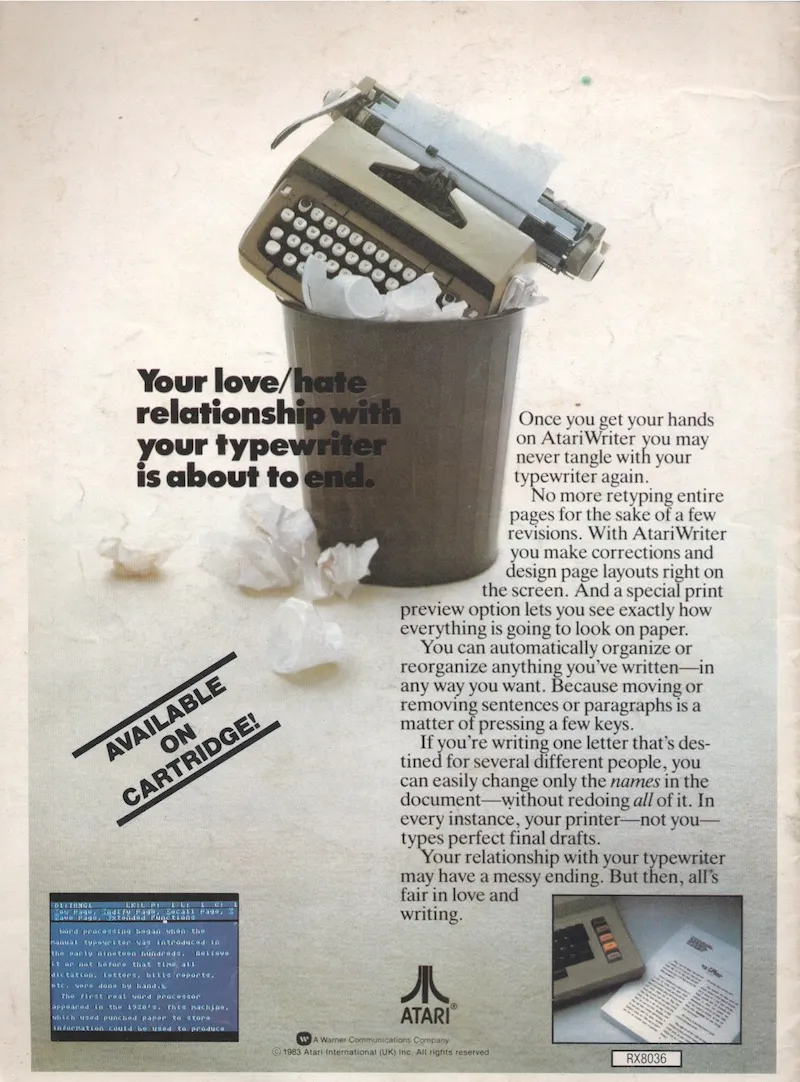
A 1983 ad for AtariWriter, which boldly proclaims "Your love/hate relationship with your typewriter is about to end".
Amstrad CPC
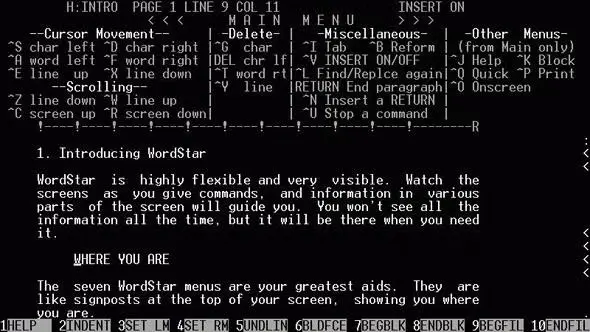
WordStar: The absolute titan of early PC and DOS productivity.
💡 Distraction-Free Trivia: To this very day, George R.R. Martin (author of A Song of Ice and Fire and Game of Thrones) writes all of his epic novels on a dedicated DOS machine running WordStar 4.0! He famously refuses to upgrade because the vintage software has no internet, no distractions, and no modern spell-check trying to "autocorrect" his fantasy names.
Apple Macintosh (1985)
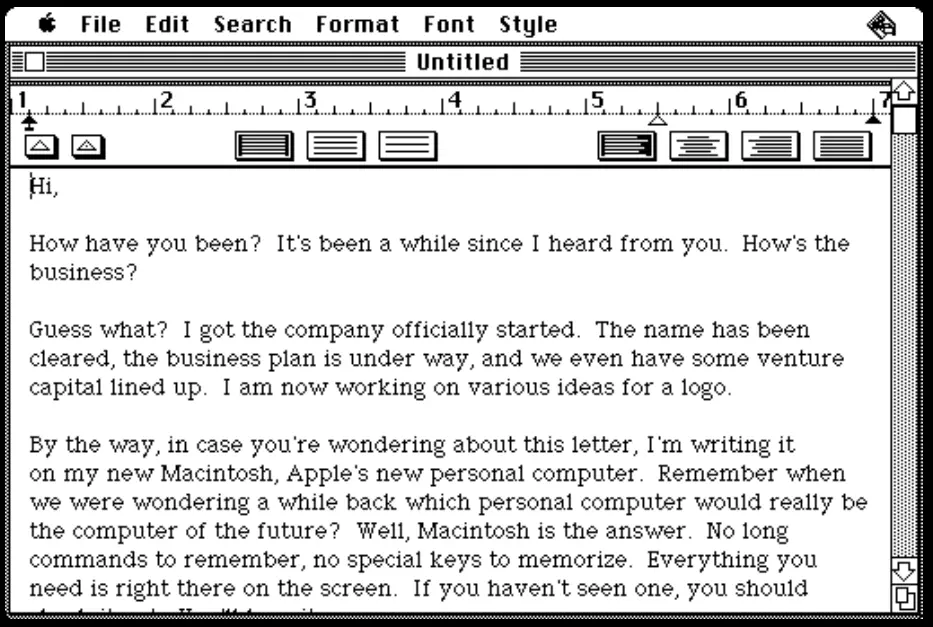
MacWrite: Not my image. Original image from Blake Patterson.
In 1984 and 1985, Apple completely rewrote the rules of digital writing with the Macintosh. For the first time, writers weren't staring at blocky, monospaced text on a green monitor. Instead, thanks to the Mac's graphical user interface and high-resolution screen, you could actually see your fonts, bold text, and italics directly on the screen exactly as they would print. This was a revolution known as "WYSIWYG" (What You See Is What You Get).
Commodore Amiga (1985)
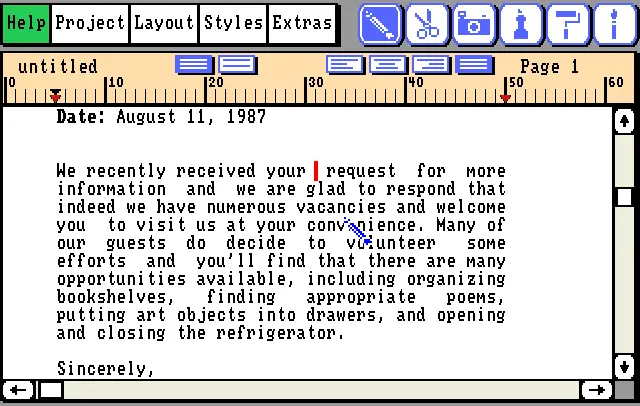
TextCraft: Not my image. Original image from Blake Patterson.
DOS Word Processors (1986-1989)
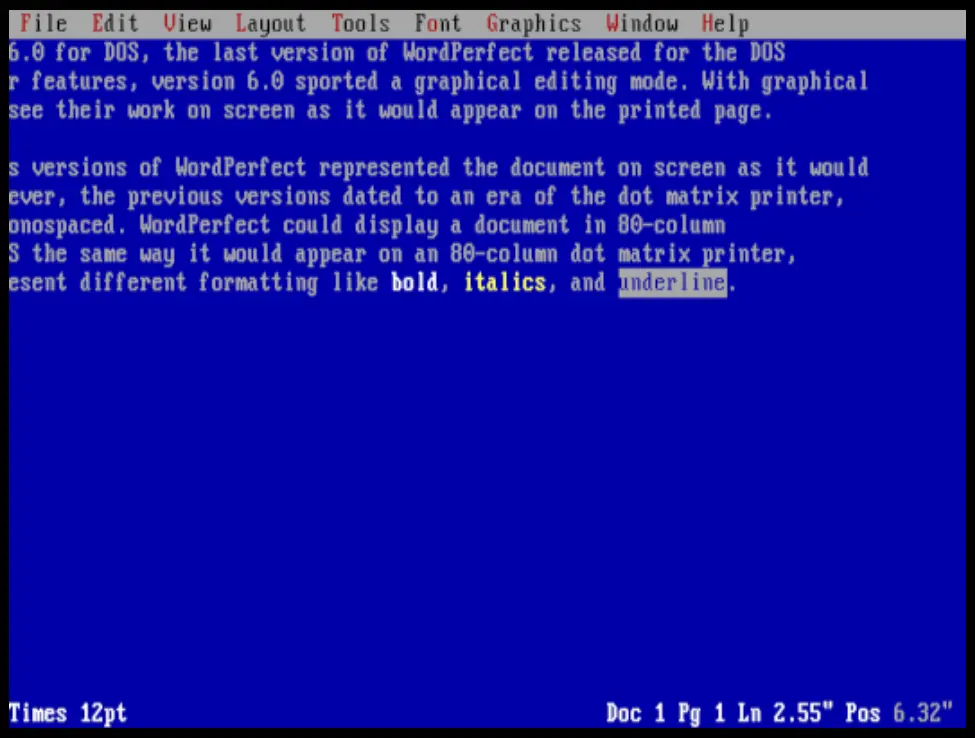
WordPerfect for DOS: Not my image. Original image from Jim Hall at Technically We Write.
- WordPerfect 4.2 (1986): This is the exact version that finally dethroned WordStar as the industry standard. Its absolute killer feature was "Reveal Codes," a brilliant split-screen view that showed you exactly where your hidden formatting tags were. If your document's layout suddenly broke, Reveal Codes let you diagnose and fix the problem in seconds. It became so beloved that legal professionals refused to give it up for decades!
- Lotus Manuscript (1987): While Lotus 1-2-3 dominated the spreadsheet market, Manuscript was their heavy-duty text engine. It wasn't meant for writing simple letters; it was specifically built for massive, complex documents like engineering manuals and scientific papers. It handled tables, outlines, and mathematical equations far better than standard word processors of the era.
- Microsoft Word for DOS version 3.0: Microsoft was determined to win the word processing war at any cost. Word for DOS was highly unique because it supported a mouse long before Windows GUIs were popular. Microsoft also wasn't above adding in some gimmicks to boost sales numbers; if you had a compatible graphics card, it could actually display bold, italic, and underlined text directly on your DOS screen instead of just changing the text color to represent formatting.
- WordStar: Even as competitors like WordPerfect rose to power, WordStar remained fiercely loved by purists. It retained its legendary "WordStar Diamond" keyboard shortcuts, which allowed touch-typists to navigate entire documents at lightning speed without ever moving their hands from the home row to reach for arrow keys or a mouse.
- IBM DisplayWrite: IBM ported this software from their incredibly expensive, dedicated standalone word processing terminals over to standard PCs. While some casual users found it clunky, rigid, and difficult to learn, it became a massive standard in corporate environments simply because it had the three most trusted letters in 1980s business on the box: I-B-M.
- pfs: First Choice by Spinnaker Software (1988): Continuing the pfs: legacy of extreme user-friendliness, this wasn't just a word processor; it was also an affordable integrated suite that included a spreadsheet, database, and telecommunications module. It was the perfect "all-in-one" package for small businesses and home users who wanted powerful tools without the intimidating learning curve (or the high price tag) of buying standalone corporate software.
If you miss the pure, distraction-free magic of these classic machines, you don't need a time machine (or floppy disks) to get it back.
<-- BACK TO RETRO JOURNAL